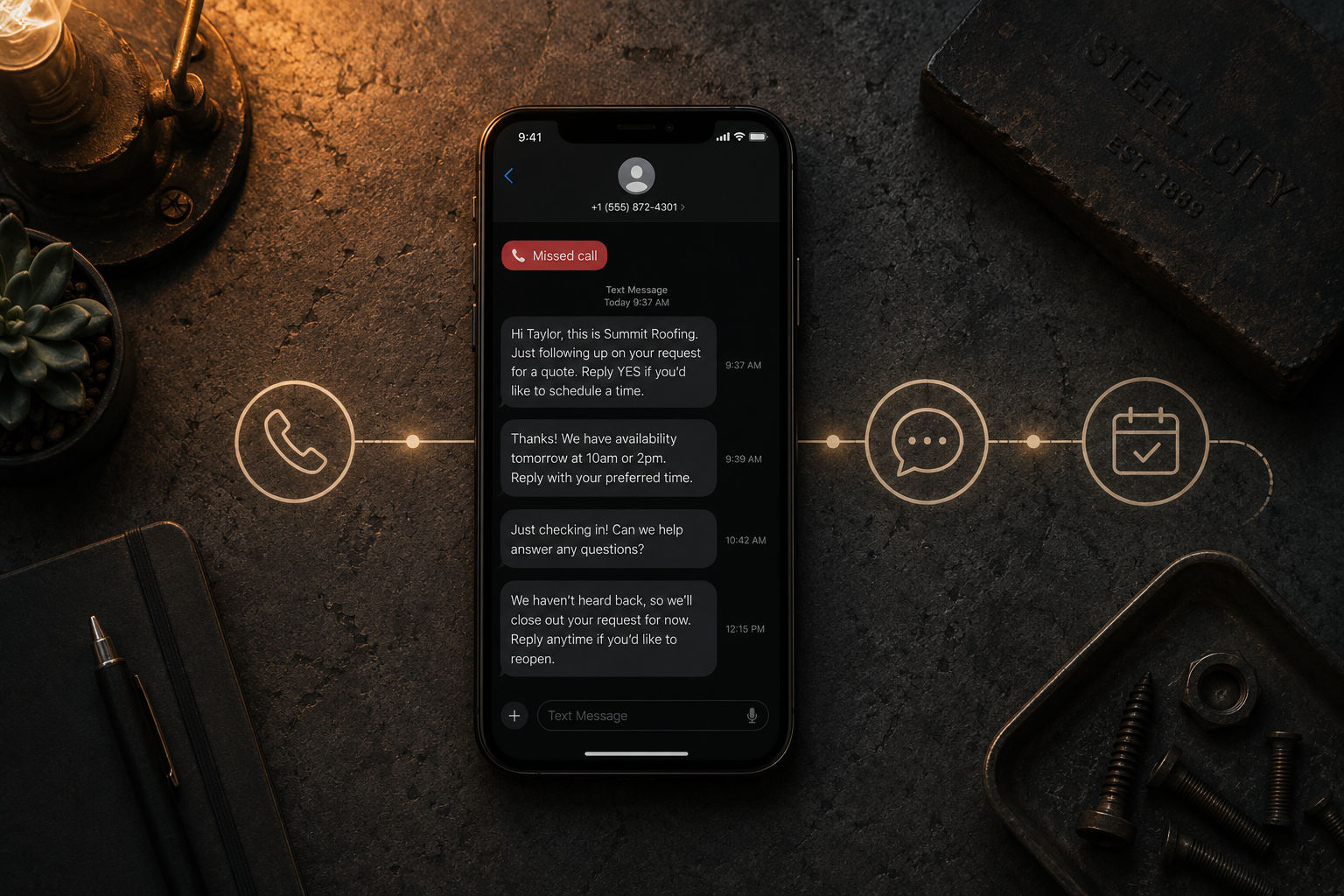
TL;DR — An automated lead follow up system sends an instant text to every missed call or web inquiry, then escalates to an AI voice agent if the lead doesn't respond. For HVAC companies, the payoff is in the jobs that came in after hours, went unanswered, and called someone else by morning.
The Problem Isn't Getting Leads — It's What Happens in the First Five Minutes
Most HVAC companies have enough inbound interest. The leak is in response time.
A homeowner's AC dies at 7PM on a Tuesday. They call the first company they find. No answer. They call the second. Same result. The third one texts them back within 30 seconds. That company gets the job. It doesn't matter that the first two were better technicians or had lower prices — they weren't there.
Harvard Business Review research puts a number on this: companies that contact prospects within an hour of an inquiry are seven times more likely to qualify the lead than those that wait. The gap between five minutes and thirty minutes is where most HVAC jobs are lost. An automated lead follow up system closes that gap by responding instantly — without a dispatcher watching a phone.
What the System Actually Does
An automated lead follow up system is a sequence, not a single tool. Each layer handles a different failure point.
Layer 1 — Missed call text back. When a call goes unanswered, the system fires a text to the caller within seconds. "Hi, this is [Company] — missed your call. What can we help you with?" The customer replies, and the conversation is now in your pipeline. This is the cheapest and highest-ROI layer. Missed call text back software typically adds $50–$99/month to your stack and recovers a meaningful portion of after-hours inquiries on its own.
Layer 2 — Automated follow up sequence. If the lead doesn't respond to the initial text within a set window, the system follows up again — once by text, once by email if you have it. Most systems run two to three follow-ups over 24–48 hours before marking the lead cold. The sequence runs without anyone touching it.
Layer 3 — HVAC AI agent. For higher-intent leads — a missed call during a peak week, a web form submission with specific details — the system escalates to an AI voice agent that calls the lead directly. The agent qualifies the job: system type, age, what it's doing, urgency. If the caller wants to book, the agent checks your live availability and writes the appointment into your scheduling software.
Not every company needs all three layers. Start with missed call text back. Add the follow-up sequence. The AI agent is for companies with enough call volume that the ROI math is clear.
The Entry Point: Auto Missed Call Text Back
Auto missed call text back is the single cheapest way to stop leads from going cold. Most HVAC companies are losing 30–40% of their after-hours calls to voicemail. A portion of those callers text back when prompted. That portion — jobs that would have been gone — is what pays for the system.
The setup is a phone number that routes through your missed call text back software. When a call is missed, the software fires the template text. The conversation happens in a shared inbox your dispatcher can monitor in the morning, or that your AI agent handles in real time.
What it doesn't do: book appointments on its own. It recovers the conversation. Booking still requires either a human or an AI agent downstream. That's why the text-back layer alone improves conversion but doesn't fully replace a live answering process.
The Full-Stack Version: HVAC AI Agent
An HVAC AI agent handles the call the way a competent dispatcher would. It answers in your company's name, asks the right diagnostic questions, checks availability, and books the job. The difference between this and a standard automated receptionist is the conversation — it handles follow-up questions, objects to price, and routes emergency calls to a human without losing the customer.
For HVAC specifically, the AI agent earns its cost during peak season. AC calls come in at 9PM on weeknights when no dispatcher is available. The agent answers all of them, qualifies the ones that are real jobs, and books the ones that want same-day or next-morning slots. The calls that needed a human — gas leak, unusual situation — get escalated immediately.
One opinion worth stating plainly: most HVAC owners underestimate the value of the follow-up layer relative to the answering layer. Getting new leads and letting them go cold because nobody follows up within five minutes is a more common problem than getting too few leads. The system fixes the pipeline, not the top of the funnel.
For a full breakdown of how the voice layer works, see HVAC contractor answering service.
What It Costs
Missed call text back software only: $50–$99/month. Setup is under an hour.
Full automated follow up sequence + CRM integration: $150–$249/month for the automation platform. Setup $300–$500.
HVAC AI agent with full booking integration: Setup $500–$1,000. Monthly $299–$499 depending on call volume.
At a $450 average ticket, two recovered jobs per month from leads that would have gone cold covers the monthly cost of the full stack. During summer peak, the math gets considerably better — not because the system works harder, but because there are more after-hours calls to catch. The Harvard Business Review lead response research has the underlying speed-to-contact data.
When NOT to Build This
Don't build an automated lead follow up system if:
- Your team is at capacity — adding more leads creates jobs you can't deliver and damages your reputation
- You don't have a scheduling system the AI can connect to — the booking automation doesn't work without it
- You're running under five calls per day — the ROI on the AI agent layer is thin at that volume
- Your conversion rate on existing answered calls is low — fix sales and dispatch first before adding volume
If your problem is lead quality, not lead volume, an AI lead generation chatbot on your website handles qualification before the call even happens.
Frequently Asked Questions
What is an automated lead follow up system?
It's a sequence of automated actions that triggers every time a new lead comes in — a missed call, a web form submission, or a chat message. At minimum it sends an immediate text. At the more complete end, it escalates to an AI voice agent that calls the lead back, qualifies them, and books the appointment without a human dispatcher involved.
How does missed call text back work for HVAC companies?
When a call goes to voicemail, the system automatically sends a text to the caller within seconds: 'Hi, this is [Company] — we missed your call. What can we help you with?' The customer replies, the conversation continues, and a booking link or an AI agent closes the job. The lead stays in your funnel instead of calling the next company on Google.
What does an automated lead follow up system cost?
Setup runs $500–$1,000 depending on how many touchpoints you're automating and which software connects to your scheduling system. Monthly is $299–$499. At an average HVAC ticket of $450, recovering two jobs per month from leads that would have gone cold covers the cost with room to spare.
How fast does the follow up need to be?
Under five minutes. Research from Harvard Business Review found that companies contacting prospects within an hour are seven times more likely to qualify the lead than those who wait longer — and the drop-off between five minutes and thirty minutes is steep. For HVAC, where a homeowner's AC is down in August, five minutes is already pushing it. The automated system fires in seconds.
Does the AI agent actually book the appointment, or does it just take a message?
A properly configured HVAC AI agent books the appointment. It checks your real availability, asks the diagnostic questions that help your tech prepare, and writes the job into your scheduling software. If the caller has a situation the agent can't handle — a gas leak, a complex warranty claim — it escalates to your on-call dispatcher immediately. It is not a message-taker.
Get a Straight Answer Before You Spend Anything
We'll look at your current call volume, estimate how many leads are going cold, and tell you honestly which layers make sense for your business right now. If the numbers don't work, we'll say so.