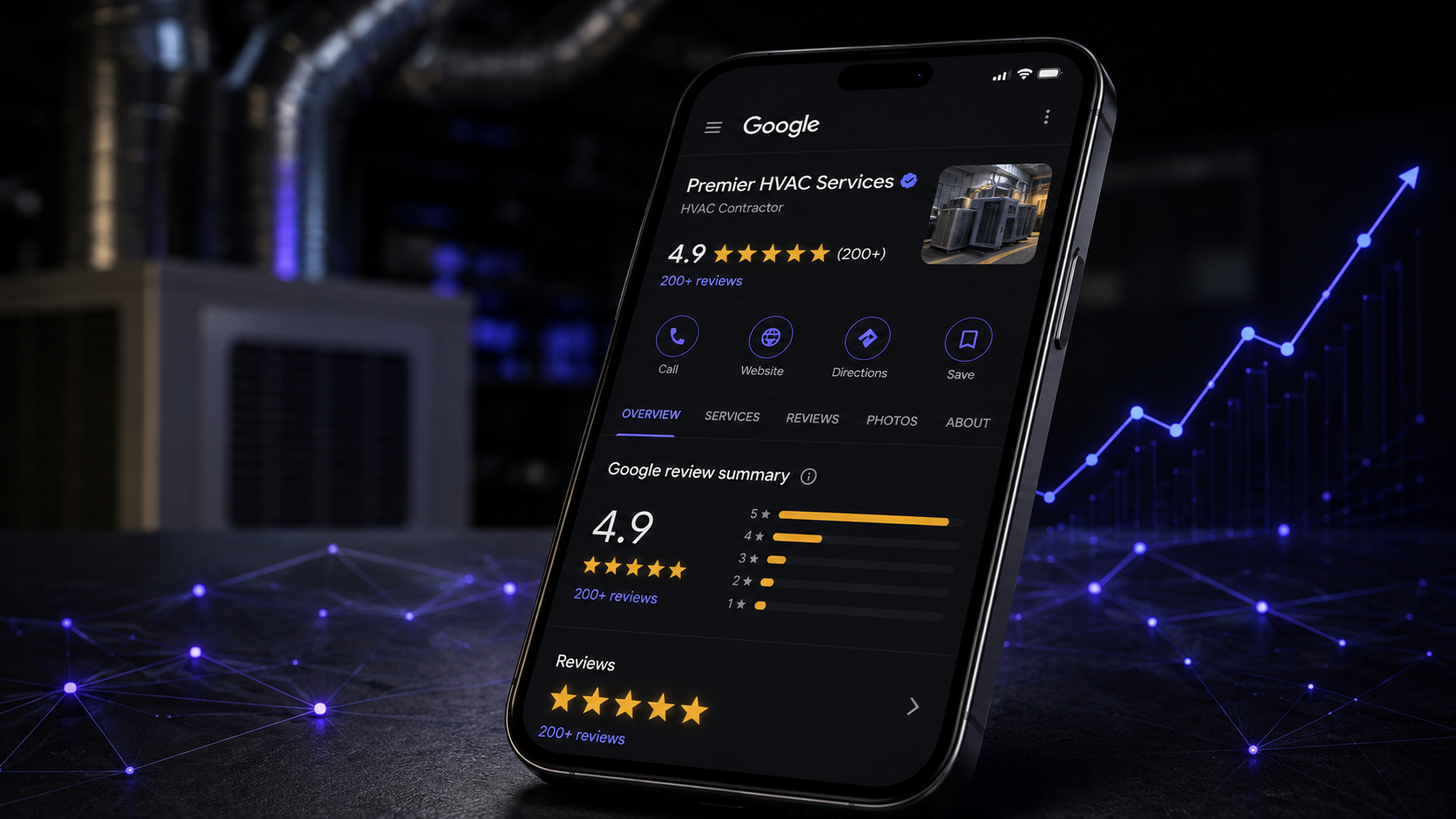
Your Google rating is deciding jobs before you know about them. 87% of consumers read online reviews before contacting a local service business. For HVAC, the decision happens even faster — a homeowner's AC is down at noon, they open Google, they call the first credible-looking result. Your rating, review count, and how you've responded to the bad ones are all visible before they dial.
Brand reputation management is the process of controlling that first impression: collecting reviews consistently, responding to negatives before they compound, and keeping your rating above the threshold where Google includes you in the Local Pack.
For most HVAC companies, this is not a marketing exercise. It's ops.
What "Reputation Management" Actually Covers
The term gets stretched to cover a lot. For a small HVAC business, the meaningful work is three things:
Review collection. Getting customers to leave reviews after a job. Most don't do it unless you ask — and the ask needs to happen within hours, not days, or they forget.
Review response. Replying to every review, including the bad ones. A thoughtful response to a negative review does more for your brand than ten five-star reviews left unacknowledged. Customers reading reviews notice which businesses respond and what they say.
Google Business Profile maintenance. Keeping your hours, services, photos, and Q&A current. An out-of-date profile loses trust before anyone reads a single review.
Reputation management pricing varies widely because vendors bundle different amounts of these three things. Know what you're buying.
Why HVAC Companies Fall Behind on Reviews
The job gets done. The customer is happy. Nobody asks for a review. Six months later you have 18 reviews and a 4.1 rating — technically fine, but not competitive against the company down the road with 340 reviews and a 4.8.
The reason isn't unhappy customers. It's friction and timing.
Most customers will leave a review if you make it easy and ask at the right moment. The right moment is 2–4 hours after the job closes, while the experience is fresh. A text that links directly to your Google review page takes eight seconds to act on. Response rates on this setup consistently run 15–25%.
Automated review collection removes the friction. The system sends the text automatically when the job is marked complete in your scheduling software. No one has to remember. Volume builds without any manual effort.
If you complete 5 jobs per day and convert 20% into reviews, that's 1 new review per day — 30 new reviews per month without any extra manual work. Most service businesses need 2–3 months of this to pull ahead of competitors.
The Search Engine Reputation Management Connection
Search engine reputation management is the same thing looked at from a different angle. Your Google rating is not just a trust signal for customers — it's a ranking input.
Google's Local Pack ranks three results for service searches. The algorithm weighs proximity, relevance, and prominence. Prominence includes review count, recency, and rating. A business collecting five new reviews a month consistently outranks one with a static profile, even if the competitor has a higher overall rating.
This is why the benefits of online reputation management for HVAC extend beyond what customers think of you. Fresh reviews directly improve where you appear when someone searches "HVAC repair near me." Your reputation is your SEO.
The Missed Call Problem and Its Reputation Cost
Every unanswered call is a potential one-star review. The customer needed help, couldn't reach you, and now associates your company with unavailability.
A missed call text back — an automatic SMS sent when a call goes unanswered — doesn't book the job, but it keeps the conversation open. "Sorry we missed you, we're on jobs right now — can we call back in 30 minutes?" That message defuses most of the frustration that otherwise turns into a negative review about your phone line.
For HVAC companies during peak season, when calls overlap and dispatchers are stretched, it prevents a specific category of reputation damage that's otherwise unavoidable.
What Reputation Management Pricing Actually Looks Like
The range is wide because the scope varies.
- Software-only: $150–$500/month. Automated review requests, a response dashboard, and reporting. Setup typically costs $500–$1,500 for configuration and integration with your scheduling software. This is the right choice for most small HVAC businesses.
- Agency-managed: $500–$2,000/month. The agency monitors your reviews, writes responses on your behalf, and handles your Google Business Profile. Useful for multiple locations. Most single-location HVAC companies don't need this level.
- Reputation repair: Higher, variable, and often not worth it. If your rating has dropped to 3.2 from a pattern of bad reviews, no vendor can fix that quickly. The only real fix is delivering better service and collecting new reviews over time. Be skeptical of vendors promising rapid rating recovery.
Online reputation management cost scales with scope. The software does 80% of the work for 20% of the price of full agency management.
When NOT to Hire a Reputation Management Company
- Your rating is above 4.3 and you're collecting reviews consistently. A basic automated follow-up via your existing scheduling software may be enough.
- Your negative reviews reflect actual service problems. Reputation management won't help. Fix the operations first.
- You're a single technician running solo. The economics rarely work. Spend that $200/month on something that directly generates calls.
- You're already overbooked. Reputation management drives demand. If you can't service what's coming in, don't accelerate it.
Most HVAC companies treat reputation management as a marketing expense. It's actually a retention system. A customer who leaves a five-star review is more likely to call you again — not because of the review itself, but because the act of articulating a positive experience reinforces it. The review ask is a touchpoint. Companies that do it consistently build a customer base that defaults to calling them before checking alternatives.
How to Automate Google Reviews
The basic setup:
- Job is marked complete in your CRM (Jobber, ServiceTitan, HouseCall Pro)
- Automated SMS fires to the customer within 2–4 hours
- Message includes a direct link to your Google review page
- New reviews trigger an alert so you can respond promptly
You don't think about it. It runs after every job. This is what Google Review Automation at SmartToolsForBiz handles — $199/month, no setup fee, live in 48 hours and fully tuned within 7 days.
Questions about reputation management for your specific situation? Call or message us. We'll look at your current review profile and tell you honestly whether paid software makes sense — or whether a manual system is all you need.