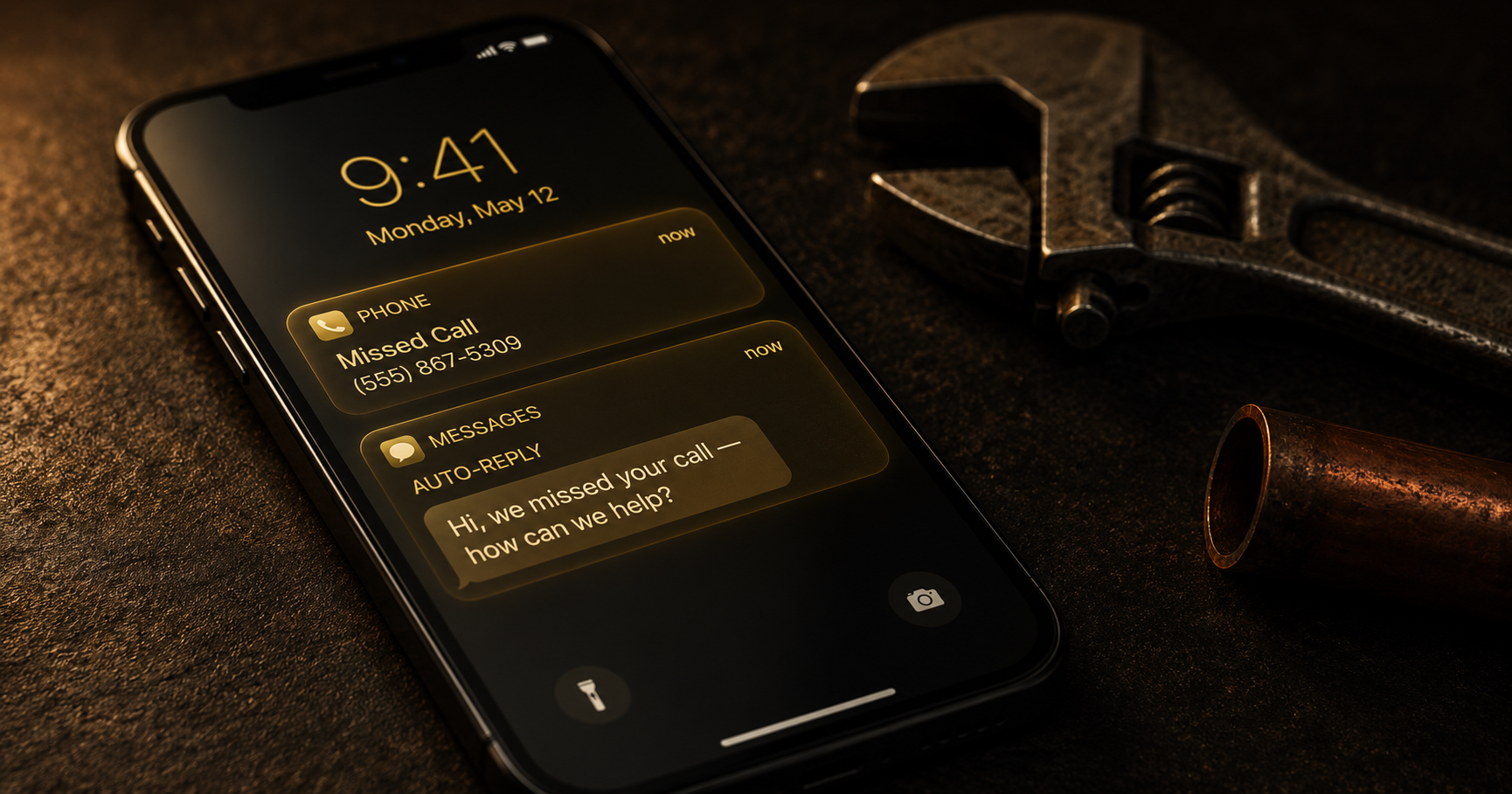
TL;DR — Missed call text back software sends an automatic SMS to every unanswered inbound call within seconds. For HVAC companies, it's the cheapest way to keep leads from going cold — a missed call doesn't have to mean a lost job if a text fires before the caller dials your competitor.
The Three-Minute Window You Keep Losing
Most HVAC companies don't have a marketing problem. They have a response time problem.
A homeowner's AC goes down on a Thursday evening. They search Google, call the first result, get voicemail, and move to the second number. The company that texts back within two minutes wins the job — not because they had better reviews or lower prices, but because they were the first to respond.
Research published by Harvard Business Review found that companies contacting prospects within an hour are seven times more likely to qualify the lead than those who wait. For HVAC calls — where the homeowner has an urgent, time-sensitive problem — that window is closer to three minutes. After that, they've already called someone else.
Missed call text back software closes that window automatically. No dispatcher, no callback list, no jobs lost to voicemail.
What Missed Call Text Back Software Actually Does
Missed call text back software detects when an inbound call goes unanswered and fires an automated SMS to the caller within seconds. The message is short and direct: "Hi, this is [Company] — we missed your call. What can we help you with?"
That single message does three things:
- Keeps the lead in your pipeline instead of letting them bounce to the next Google result
- Opens a two-way text conversation your team can pick up in a shared inbox
- Signals professionalism — most competitors don't follow up at all after a missed call
It is not a full answering service. It doesn't answer the call, take a message in real time, or book appointments on its own. What it does is buy back the conversation — a lead that would have been gone in three minutes is now waiting for your reply.
For after-hours calls — which make up 30–40% of HVAC inbound volume during peak season — this is the difference between a job in your CRM in the morning and a job that called your competitor while you slept. See the full breakdown of what missed calls actually cost an HVAC business.
How Auto Missed Call Text Back Works Step by Step
The mechanics are straightforward once you see the full flow:
- Inbound call comes in. The caller dials your business number — which routes through your missed call text back platform, not directly to your cell or office line.
- Call goes unanswered. No one picks up within the configured number of rings. The call drops to voicemail or disconnects.
- System fires the SMS. Within 15–30 seconds, the platform sends a pre-configured text to the caller's number. Message, tone, and timing are all customizable.
- Two-way conversation opens. When the customer replies, the response routes to a shared inbox — visible to your dispatcher, CSR, or AI agent. The conversation continues in real time or is picked up when your team comes back online.
- Lead gets tagged and tracked. Most platforms log the missed call and the resulting conversation in a built-in CRM or sync with your existing one. Nothing falls through the cracks.
The whole process is invisible to the caller — they experience a responsive company, not automation. That perception matters for HVAC, where the customer is already stressed about a broken system and quick response is a direct trust signal.
One critical setup detail: the business number the caller dials must route through the platform. If they're calling your personal cell directly, text back won't trigger. The platform number needs to be your advertised number — Google Business Profile, website, and any ads — or the system only catches a fraction of your missed calls.
What to Look for in a Platform
Not all missed call text back tools are built the same. Here's what separates a useful setup from a frustrating one:
- Response speed configuration. You want a system that fires in under 60 seconds, ideally under 30. Some cheaper tools have delays of several minutes — long enough for the lead to already be gone.
- Customizable message templates. The default text matters. A generic "we'll call you back" performs worse than a warm, specific opener that mentions the company name and invites a reply.
- Shared team inbox. The reply needs to land somewhere your team can see and act on — not just forward to an email that gets buried. A proper shared inbox with read/unread states is non-negotiable.
- CRM integration or built-in pipeline. Missed calls should automatically create a lead record. If you're manually logging every text conversation, the system is creating work instead of eliminating it.
- After-hours routing rules. The text that fires at 2PM on a Tuesday should differ from one at 9PM on a Saturday. Business hours configuration and different message templates for each window make the system feel less robotic and convert better.
- AI escalation option. The better platforms let you route an unanswered text conversation to an AI agent that continues qualifying, checks availability, and books the appointment — without a human involved.
For HVAC companies specifically, integration with your scheduling software (ServiceTitan, Jobber, Housecall Pro) is the feature that determines whether the system is a full lead recovery tool or just a text-logging tool.
What It Costs
Entry-level (SMS automation only): $49–$99/month. These tools handle the trigger and the send, usually with a basic inbox. A good starting point if you're testing the concept.
Full platform (CRM + pipeline + sequences): $97–$299/month depending on contact volume and features. Platforms that include follow-up sequences, pipeline tracking, and review request automation alongside text back fall in this range.
Setup: $200–$500 if you're paying someone to configure it properly — number porting, message templates, CRM integration, after-hours rules. Skipping proper setup and running default settings is the main reason companies say the tool "didn't work."
The ROI math: At a $450 average HVAC ticket, recovering one job per month from a lead that would have gone cold pays for the monthly platform cost outright. Most HVAC companies running volume see two to four recoveries per month within the first 90 days. The peak-season multiplier is where the real return shows up — more after-hours calls means more opportunities to recover.
For a full breakdown of what the complete lead response stack costs beyond text back, see building an automated lead follow up system for HVAC.
When Text Back Alone Isn't Enough
Missed call text back is the cheapest and fastest layer to deploy. It is not a complete solution.
Two scenarios where it falls short:
High-urgency calls. A homeowner with no heat in winter or a suspected gas issue isn't going to wait for a text reply and a back-and-forth conversation. They need a live voice or an AI agent that picks up immediately and escalates to your on-call tech. For those situations, an after-hours virtual receptionist handles the call in real time. Text back is the safety net for calls the answering layer misses.
No one monitoring the inbox. If your team is in the field all day with no one watching replies, text conversations go cold anyway. The text fires instantly but the reply comes six hours later — you've had the same problem, just with an extra step added. The fix is either a dedicated inbox review window in the morning or routing conversations to an AI agent that continues them in real time.
The most effective setup for HVAC companies with real call volume: a live HVAC contractor answering service as the primary layer, missed call text back as the secondary, and an AI follow-up agent that qualifies and books from the text conversation. All three run together for under $600/month.
According to industry SMS benchmark data, text messages have a 98% open rate compared to 20% for email — which is why text back outperforms voicemail callbacks as a lead recovery method by a significant margin.
Frequently Asked Questions
What is missed call text back software?
It's software that detects an unanswered inbound call and automatically fires an SMS to the caller within seconds. The message opens a two-way text conversation your team — or an AI agent — can continue. Instead of losing the lead to voicemail, the caller gets an immediate response even when no one picked up.
How fast does the text go out after a missed call?
Properly configured systems fire within 15–30 seconds of the call going unanswered. Speed matters because the caller is already deciding whether to dial the next company on Google. A text that arrives in under a minute keeps you in the conversation; one that arrives in 20 minutes usually finds the job already booked elsewhere.
What does missed call text back software cost?
Entry-level tools focused on SMS automation alone run $49–$99/month. Full platforms that bundle CRM, follow-up sequences, and pipeline management start around $97–$299/month. Expect a one-time setup fee of $200–$500 if you're paying someone to configure, test, and integrate it with your scheduling system.
Does missed call text back book appointments?
It opens the conversation — booking requires a human or an AI agent downstream. The text back recovers the lead from going cold. Closing the job still needs either a staff member replying through the shared inbox or an AI voice agent that follows up with a call. The two work best together.
What's the difference between missed call text back and an answering service?
An answering service intercepts the call before it goes unanswered — a live operator or AI voice agent picks up in real time. Missed call text back fires after the call is already missed. They solve different failure points. Most HVAC companies benefit from both: an answering service as the primary layer and text back as the safety net for calls that slip through anyway.
Will customers actually respond to an automated text?
Yes. SMS open rates run around 98%, and response rates for service business text-back messages typically fall between 20–35% depending on urgency and timing. In practice, roughly one in four leads that would have gone cold comes back into your pipeline. During peak season — when callers have an urgent problem — the response rate trends higher.
See How Many Leads You're Currently Losing
We'll look at your call volume, estimate how many missed calls are going cold each month, and show you what a properly configured text back setup would actually recover. Takes 20 minutes.