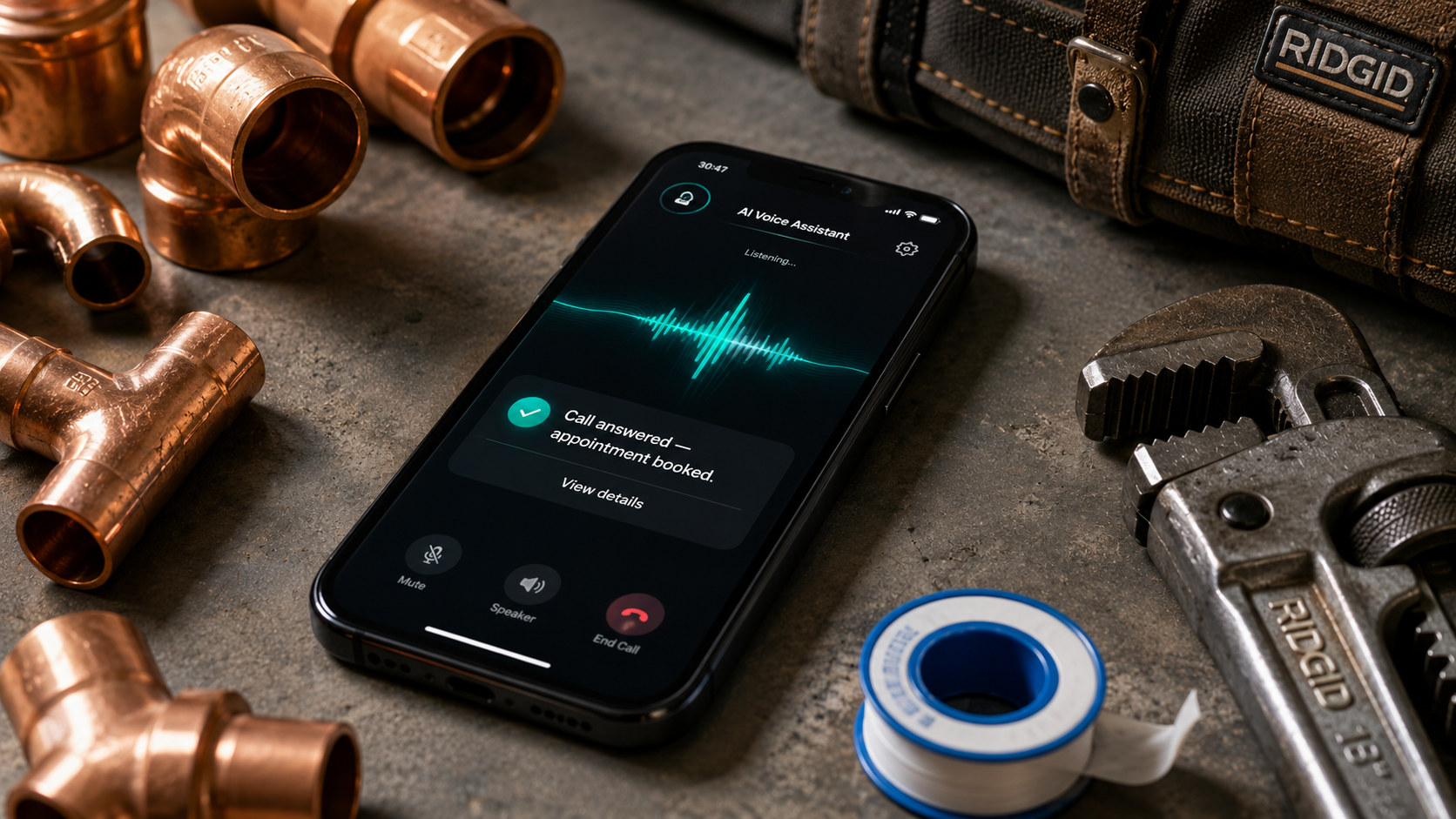
A traditional call answering service takes a message and sends it to you. AI receptionist software books the appointment before the call ends.
That difference — message versus booked job — is the only thing that matters when choosing between them.
For plumbers, the gap is especially sharp. You're not sitting at a desk. You're in a crawlspace, under a sink, or elbow-deep in a drain. When a call comes in, it either gets answered automatically or it doesn't get answered at all. Most don't.
What AI Receptionist Software for Plumbers Actually Does
The core function is call handling with qualification. When a new call comes in, the AI answers in your business name, works through a scripted conversation, and routes the call based on what you've configured.
For plumbing, that qualification looks like: what's the issue, is water actively going where it shouldn't, what's the address, what does your availability look like.
From that conversation, the AI does one of three things:
- Books the appointment directly into your scheduling software (Jobber, ServiceTitan, or similar)
- Escalates to your on-call line if it's an active emergency — burst pipe, water heater failure
- Captures the lead and sends a structured handoff to your dispatcher
The outcome is a confirmed appointment in your schedule. Not a callback list. That distinction matters because of what happens in the gap between message and callback: most customers don't wait. They call the next result on Google.
How It Compares to a Live Plumbing Call Answering Service
Live answering services for plumbers typically cost $200–$400/month. Their operators take a message, log the caller's name and issue, and forward it to you. You call back when you can.
The problem isn't the operators. It's the delay. Most plumbing customers — especially ones calling about urgent issues — wait about four minutes before moving to the next search result. A message logged at 7PM doesn't become a callback until 8AM. By then, a meaningful portion of those leads have already booked someone else.
AI receptionist software for plumbers closes that gap by answering and booking in one call. No second step. The customer confirms the appointment, receives a text confirmation, and the job appears in your schedule before you finish the current one.
The monthly cost is similar: a live plumbing answering service runs $200–$400/month. AI receptionist software runs $299–$499/month. The difference isn't the price. It's what you have when you open your schedule in the morning.
What to Look for in AI Receptionist Software for Plumbers
Not all AI receptionist software is built the same. For plumbing businesses specifically, the features that matter:
- Scheduling software integration. If the AI can't connect to Jobber, ServiceTitan, or whatever you're running, it can only capture the lead — not book the job. Ask about this before signing anything.
- Escalation paths. A burst pipe or active flood is not a "leave a message" situation. Good software has configurable escalation: the AI can transfer to your on-call number, page your dispatcher, or fire an emergency alert based on what the caller describes.
- After-hours coverage. The calls you most want to capture — burst pipes, failed water heaters, frozen lines — happen at 9PM or on a Saturday. A 24/7 plumbing answering service built on AI has no coverage gaps.
- Missed call text back. For callers who hang up before the AI picks up, an auto missed call text back fires an SMS within 60 seconds. It's a fallback layer, not a primary strategy.
- Lead qualification logic. The AI should ask plumbing-specific questions to determine urgency and route the job correctly. A water heater making noise is a different call than water coming through the ceiling.
The Plumbing Problem That Live Answering Services Don't Solve
Most service businesses talk about after-hours coverage as the main gap. For plumbing, the bigger problem is mid-job coverage.
An HVAC company might have someone in the office to grab a call at 2PM. A solo plumber or two-person operation doesn't. The phone rings while you're under a sink. Your options: stop the job to answer, let it go to voicemail, or have the AI handle it.
Voicemail loses the job in most cases. Calls that reach voicemail during business hours have a 20–30% abandon rate — two or three out of every ten callers don't leave a message at all. They hang up and call the next result.
The industry sells call answering services as an after-hours product. For plumbers, the real value is all-hours. The calls you lose at noon on a Tuesday are the same problem as the calls you lose at midnight. An automated receptionist running around the clock solves both.
When NOT to Use AI Receptionist Software
- If you're already at capacity and can't take on more jobs. Booking more calls creates scheduling problems, not revenue. Fix the capacity constraint first.
- If you have a dedicated office person answering consistently and your only gap is after-hours. You may not need a full AI receptionist — a narrower solution might be enough.
- If your average ticket is below $150. At $285/ticket, two recovered calls cover the monthly fee. At $150, you need four. Possible, but confirm the math with your own call volume first.
- If most of your business comes from repeat customers who always get through. AI receptionist software earns its ROI on first-contact callers — people finding you through Google who won't wait for a callback.
What It Costs
Setup: $500–$1,000. This covers the voice agent build, qualification flow, scheduling integration, and escalation configuration.
Monthly: $299–$499 depending on call volume and integration depth.
Automated lead follow-up add-on — SMS and email sequences for quotes that go cold or leads that don't book immediately — is $299/month separately, or available bundled.
At a $285 average plumbing ticket, the break-even is two recovered calls per month. During a burst-pipe event when your phone is ringing while you're working, most operators hit that in a single week.
Not sure if this makes sense for your business? We'll look at your call volume and give you a straight answer — including if the numbers don't work. Call or message us. No pitch.